The 51st
On the Perplexing Proposal of a Fifty-First State

From time to time, an idea surfaces in the United States that Canada might sensibly join the Union as its fifty-first state. The reasoning appears to be that we share a border, a language (in part), an economy, and some passing enthusiasms for each other’s cultural exports. With this view, the border is little more than an untidy pencil mark on a map, awaiting erasure by a decisive hand.
This is agreeable in its simplicity, but simplicity has never been a reliable measure of truth. The similarities in question are purely superficial, beneath which run deep and incompatible currents. They are not ornamental details to be adjusted; they are the structural beams upon which two very different political houses stand.
The divergence begins with the ideals to which each country has long pledged itself. The United States is guided by Life, Liberty, and the Pursuit of Happiness: an anthem to the primacy of the individual, with the state regarded as something to be kept under polite but firm suspicion. Canada follows Peace, Order, and Good Government: a creed that places harmony and public welfare at the centre of politics and treats the state as a legitimate agent for both. These guiding phrases have acted for generations as compasses, sending each nation along trajectories that rarely intersect except at the border.
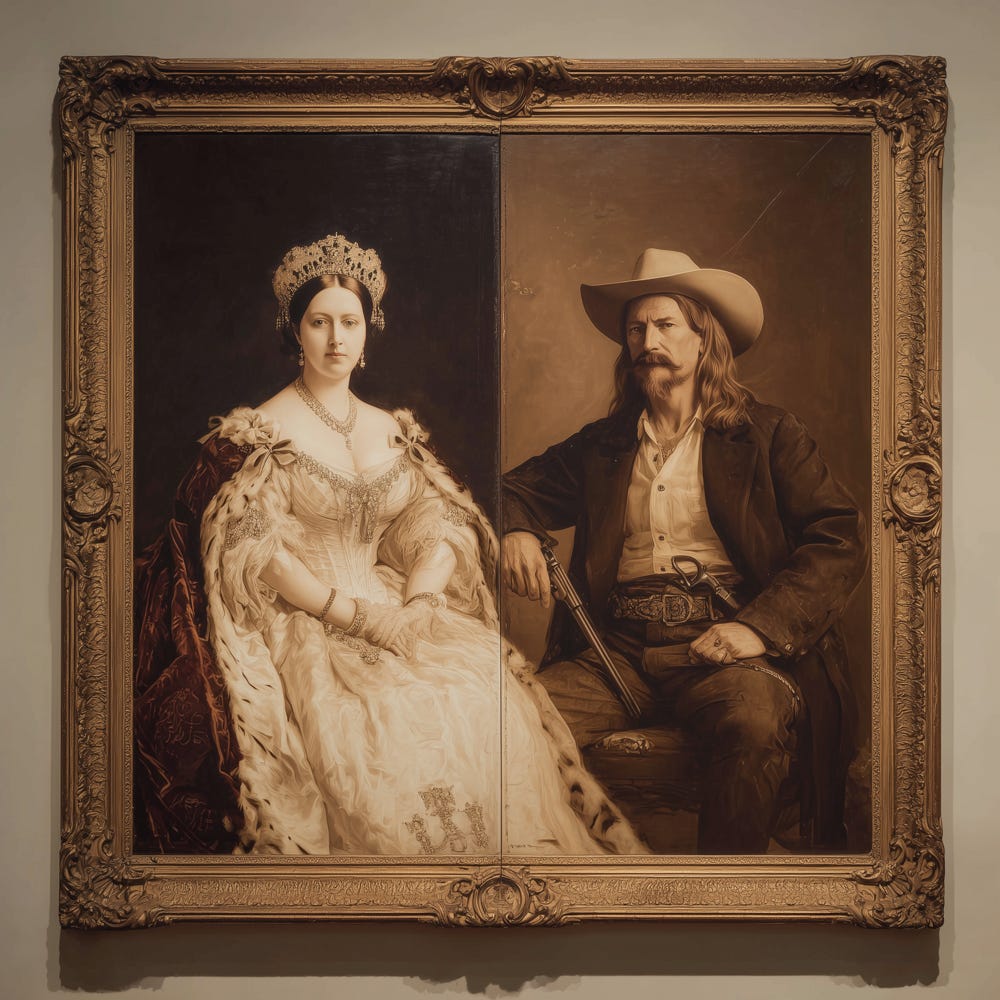
To illustrate the contrast, one might borrow from the gallery of history. Canada is Queen Victoria: composed, procedural, possessed of a belief that a proper outcome is inseparable from a proper process. The United States is Wild Bill Hickok: confident, ungovernable, and convinced that the best way to keep order is to carry it openly on one’s hip. Both are recognisably human, but to suppose they might thrive under the same roof is to mistake civility for compatibility.
The distinction is further embedded in the machinery of government. Canada’s parliamentary system, with its appointed Senate and Supreme Court, both subject to mandatory retirement at seventy-five, stands in deliberate contrast to the United States’ presidential arrangement, elected Senate with no term limits, and Supreme Court whose members serve for life. Policy reflects the same separation: Canada’s universal healthcare, stringent firearms regulation, and bilingual federal administration would arrive in Washington as strangers, and perhaps as suspects.
These differences matter not because they are curious, but because they define each country’s conception of itself. They shape the citizen’s expectations of government and the government’s sense of duty to the citizen. To merge them would be less an act of political unification than a feat of constitutional taxidermy, producing a creature that looked plausible only to the casual eye.
Even were such obstacles ignored, there is the question of arithmetic. Canada would not arrive as a single, acquiescent state but as at least ten, more likely thirteen, each entitled to representation. Twenty-six new Senate seats and perhaps fifty in the House would alter the composition of Congress beyond recognition. Given Canadian voting tendencies, it is not unthinkable that the Republican Party would discover a new vocation as a permanent opposition, and that American politics might come to accommodate a President Trudeau or, a novelty in some quarters, a francophone Speaker.
The truth is that the border is not an arbitrary scrawl, but the visible edge of two quite different designs — one a Victorian portrait, the other a tableau from the frontier. They share a continent, and on occasion a turn of phrase, but the notion that they are essentially the same is an error both of geography and of judgment.