Second Author, First Draft
Rethinking Creativity and Collaboration in the Age of Generative AI

How might one work productively with artificial intelligence (AI)?
As generative AI becomes increasingly present in the creative process, we’re urged to reconsider authorship, originality, and collaboration itself. This essay offers a personal reflection on what it means to work alongside AI—not simply as a tool, but as a second voice in the room.
Does artificial intelligence mark a pivotal moment in the history of technological innovation? Possibly. But we might ask, as James Burke once did in his series Connections, whether the most consequential effects of a technology are always the ones its inventors foresee. This is a note of both caution and opportunity. Burke recounts the role of the stirrup in the Norman Conquest of England in 1066—not because it was a novel technology per se, but because it enabled a new style of mounted cavalry warfare. He argues that the Normans’ enhanced battlefield mobility and control, afforded by the stirrup, helped secure their victory at Hastings. The long-term consequence? Norman French supplanted the language of the elite, ultimately shaping the English language itself. “Had the Normans not had stirrups,” Burke speculates, “we might all be speaking Saxon.”¹ The point is clear: it is often not the technology alone, but its unanticipated entanglements with culture, power, and the unpredictable circumstances that shape history.
AI may not yet rival the wheel or fire in civilisational impact, but it already exhibits signs of becoming a similarly consequential innovation; its effects likely to unfold less through grand proclamations than through the slow accumulation of secondary effects, refracted through institutions, practices, and imagination.
The area that is of particular interest to me, and has drawn broad attention, is the creative potential of AI. Can it write? Can it paint? Can it think? These are important questions, but perhaps also premature. Much of the recent discourse focuses on whether AI can create, and we implicitly measure its outputs against human standards of originality, intention, and authorship. The results—though increasingly impressive—are not yet fully convincing. Current generative systems do not reason. They do not witness. They simulate fluency, using statistical approximations of language and image, rather than producing work rooted in logic, situated experience, or truth.
And yet, to dismiss these systems outright would be to miss their real value. Generative AI, for all its limitations, offers something functionally powerful: it can assist in idea development, provoke critical thought, and help articulate a direction that a human creator may later refine, shape, and make their own. In this light, the question “Can AI create?” becomes less relevant than “What does it mean to create with AI?”
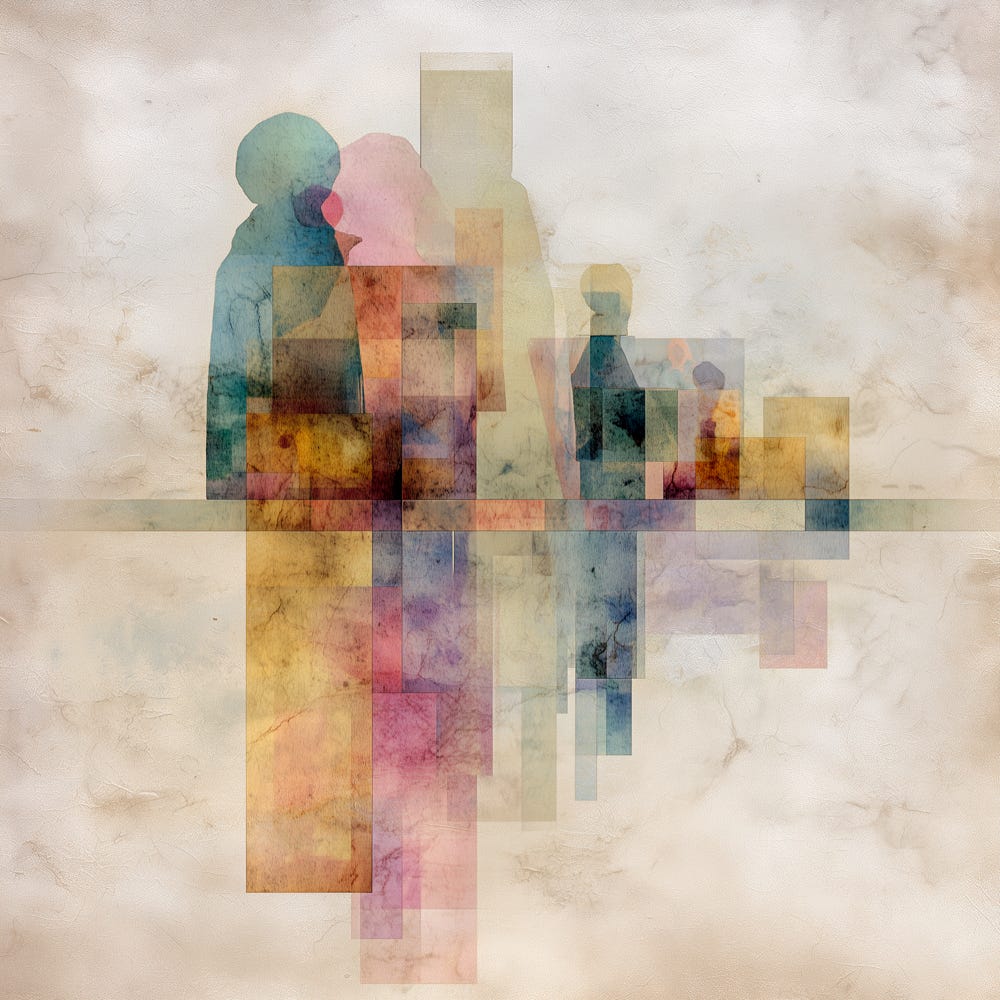
Joanna Zylinska, Professor of Media Philosophy and Critical Digital Practice at King’s College London, argues for a post-humanist understanding of creativity. In her view, creativity is not a property of the individual human mind, but an emergent quality of relational systems—comprising humans, technologies, archives, environments, and machine agents. Thus AI need not ‘be creative’ in the human sense, rather how does it contribute within a hybrid constellation of human and nonhuman participants.²
This idea resonates strongly with my own working method. Collaboration plays a role in both the ideation and production phases, but in different ways: ideation benefits from dialogue, contrast, and provocation; production often requires support, refinement, and technical skills. One can have rich conceptual insights without being fluent in the tools of production, just as one might write fluently without the ideas to convey. In this context, AI offers a form of partnership: it can assist in developing ideas, proposing connections, or mapping the conceptual terrain—and it can also support the execution of work, through editing, drafting, or stylistic experimentation. Why shouldn’t we enlist it in both?
In my practice, AI has become a writing partner—not a replacement for authorship, but a stimulus and assistant. I use it in early research to survey the different perspectives, structure arguments, and reveal internal contradictions. As I age, I’ve noticed my fluency has slowed. Word selection is less agile. My patience for stylistic refinement has waned. Yet my ideas remain active. AI fills this gap: not by completing the work for me, but by helping me find the words I already know, to test phrasing, to ask what Fowler would suggest.
Still, caution is warranted. Generative AI does not produce truth. It silently hallucinates. It draws from historical and often biased corpora, embedding unexamined cultural assumptions in its output. It may seem coherent, yet promote exclusionary or distorted perspectives. It can be political—whether overtly or subtly—and often defaults to the aesthetic or ideological norms of its training data. But even here, its value may be indirect: the potential for failure forces us to look more closely at its results. It prompts critical inquiry, demands verification, and can even lead to deeper understanding.
This is, perhaps, the post-human condition that Zylinska envisions: not a surrender of human agency, but a transformation of how we conceive agency itself. Creativity, in this light, is not a singular act but a networked emergence—one that includes the archive, the algorithm, the interface, and the human imagination. To engage with AI creatively is not to lose the self, but to acknowledge that we have never created alone4.
References
James Burke, Connections, episode 1: “The Trigger Effect,” BBC, 1978.
Joanna Zylinska, “AI Art: Machine Visions and Warped Dreams” (London: Open Humanities Press, 2020).
Joanna Zylinska, “We Are All Machines: AI Art and Post-Humanism,” *Burlington Contemporary*, accessed August 2, 2025, https://contemporary.burlington.org.uk/reviews/reviews/we-are-all-machines-ai-art-and-post-humanism.
Joanna Zylinska, “Undigital Photography,” *Images*, no. 31 (2022): 79–92, https://pressto.amu.edu.pl/index.php/i/article/view/36929.
Joanna Zylinska, *Minimal Ethics for the Anthropocene* (London: Open Humanities Press, 2014), https://openhumanitiespress.org/books/titles/minimal-ethics-for-the-anthropocene.
Your thoughts of collaboration re AI and people, fit right in with Italian Field Theory.😊